‘Stop Gentrification Through Ownership’
By ZHATEYA JONES
Tuesday’s Forum was a masterclass in land and home ownership, in development strategy, in how public policy impacts development, and the opportunities people in the sector have to make money while also supporting community responsibility.
Bobby Drakeford didn’t begin with numbers. He began with his truth. “A lot of what hasn’t happened is based on conversations that haven’t happened.”
A native Charlottean who grew up behind Friendship Missionary Baptist Church on the West Side, Drakeford’s story is deeply tied to the city’s transformation. His father was both a small business owner and a professor at Johnson C. Smith University, later becoming a broker – an influence that introduced Drakeford to real estate after he returned to Charlotte in 1991 as a tax attorney.
He remembers when homes in neighborhoods like Wesley Heights, Plaza Midwood and Greenville were affordable, and he noticed something critical early on:
The people buying and holding land were mostly white, because they understood its future value.
Now, Drakeford is working to shift that reality. His current developments near Statesville Avenue and Harding High School include affordable, for-sale units, a deliberate move to create ownership, not just housing.
His model is simple, but powerful: Affordable homeownership is the foundation for wealth in Black communities.
Todd Collins, CEO of Red Hill Ventures, brought a different lens.
Raised in Houston, Collins’ parents\ grew up picking cotton, but it was on land they owned on land they owned, Collins once thought that experience was normal, until he arrived at Morehouse College and realized just how unique it was. He joked that classmates asked if his parents were slaves.
Colliins took to heart how transformative it was that his parents owned the land. His first deal was as practical as it was transformative:
Bought a property for $15,000. Fixed it up. Sold it for $30,000. Reinvested – without spending his own money.
Collins said he spent eight years balancing a full-time job while building his real estate portfolio in this way, before going all in.
Now operating across D.C., North Carolina and Texas, his strategy is rooted in value creation – buying undervalued or under-managed assets, redeveloping them into thriving spaces, creating ecosystems where businesses feed into each other’s success.
One example is his recent acquisition of The Boardwalk at University Place, redeveloping with new tenants like Brixx Pizza and local bakery concepts. “Your goal is that every new tenant you bring makes the others successful.”
Shawn Kennedy says he often introduces himself as “Queen Esther’s grandson.” He graduated from Morehouse College, and before leaving Atlanta he opened 5 clothing stores. He also launched a bar at age 22, a move he admits now “was not a good idea.”
After arriving in Charlotte, he opened multiple restaurants and nightlife ventures across Charlotte. But everything changed in 2009 when he discovered real estate.
With no formal roadmap, Kennedy began knocking on doors in NoDa, buying single-family homes starting at $13,000. He learned the business in real time. “There was no plan,” he said. “I was building the plane while flying it.”
Today, that same man is preparing to release over 700 affordable housing units, all designed as for-sale products, not rentals. His projects include some in Hidden Valley, others on Beatties Ford Road adjoining the Excelsior Club.
Asked what developers really do, panelists said that developers are not construction companies. As Kennedy explained, developers focus on a vision, secure financing, navigate city relationships and zoning, then hire a construction company.
When asked if gentrification could happen “safely” without displacing communities of color, Collins didn’t hesitate: “There is one way to prevent gentrification. And it’s that we own the properties.” It was one of the most direct statements of the morning.
Ownership, he emphasized, doesn’t start with luxury, it starts with entry: small investments, delayed gratification, and understanding how money wisely invested can grow, or appreciate. Once land is owned, displacement becomes far less likely.
Kennedy said he regularly holds meetings with residents of communities adjoining his projects. He said the average age of people at community meetings is around 60. Younger generations aren’t showing up. When they come, he said, he said the mindset is “Why would I want to live in the hood?” Kennedy challenged that thinking directly, pointing out that communities are often only valued after they’ve been transformed and original residents have been priced out.
Drakeford brought the conversation back to public policy, specifically, zoning overlays and transit-related rezoning discussions impacting areas like West Boulevard.
His stance was clear: Some zoning overlays are not favorable to Black communities. Residents need to police the equity of development, and understand that policy decisions shape not just buildings, but who gets to stay.
As the panel closed, SISTAH Magazine asked this: Is development a male-dominated industry, and how can Black women enter and compete? Todd Collins didn’t hesitate.
Real estate development, he said, is a white male-dominated industry, and in all his years across multiple markets, he could point to only one Black woman operating at a highly competitive level. Dionne Nelson, a graduate of Spelman College, is known for leading and executing large-scale development projects. But the weight of his answer wasn’t just in who he named. It was in what followed:
He knew only one Black woman in the industry with that level of success.
In an industry that shapes land, policy, wealth, and the physical future of cities, that reality is more than a gap. It’s a call to action because development is not just about construction, it’s about control, ownership, and influence. And without Black women in those rooms, structuring deals, leading projects, and owning land, entire perspectives are missing from the blueprint.
The question, then, is no longer just how to enter. It’s how to intentionally build pathways, access, and capital pipelines so that Black women are not the exception, but a defining force in the future of development.
.
Challenges explored
By DAVID MILDENBERG
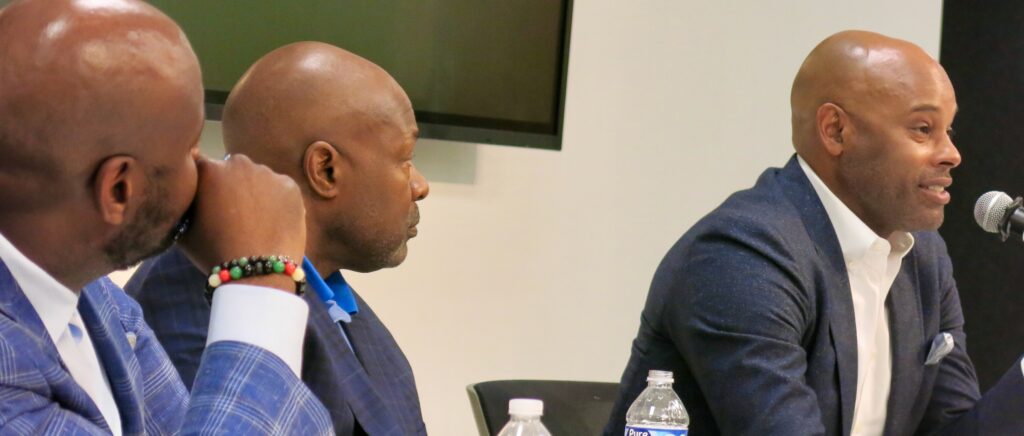
Three prominent Black Charlotte real estate developers spoke at the weekly Sarah Stevenson Tuesday Forum, sharing insights on why they remain outliers in an industry that they said remains dominated by white males.
The speakers at the forum were:
- Todd Collins of Red Hill Ventures, which has developments in North Carolina, Texas, Maryland and Washington, D.C. He said his business owns or is developing more than 1,000 apartment units within a few miles of the Belmont neighborhood center near Uptown Charlotte, where Tuesday’s event was held.
- Shawn Kennedy of Prosperity Alliance is working on a 39-unit town-home development in the Hidden Valley neighborhood in northeast Charlotte. He is leading redevelopment of Charlotte’s Excelsior Club, a longtime center for the city’s Black community.
- Bobby Drakeford of the Drakeford Company, who Kennedy described as the “godfather of Black developers” in Charlotte because of his decades as an industry pioneer, following five years working for Trammell Crow. Drakeford said he is working on about four housing projects now, with plans to start two more over the next year. Like Kennedy, he said a main emphasis is creating home-ownership opportunities to help buyers build wealth, he said.
A major issue in Charlotte real estate is gentrification, with many center city neighborhoods shifting demographically as some longtime Black residents leave due to rising rents and higher property taxes.
Asked about the subject, Collins urged Black residents to invest in real estate to build wealth and gain leverage. “The way to prevent gentrification is to own the property,” Collins says. He noted how his first real estate investment was a $15,000 home in Houston that he later sold for $30,000, starting a chain of sales that enabled him to leave his job at Accenture to start his own development business.
Collins said Red Hill has had significant success with the East Town Market retail center in east Charlotte, where occupancy increased from 30% to more than 90%. In September, Red Hill bought The Boardwalk at University City, near the UNC Charlotte campus. They are renovating the retail and office space and attracting new tenants, including Brixx Pizza.
Red Hill uses its own capital rather than raising specific funds, which enables the business to work at its own pace and sell for a profit at the time of its choosing, not when a loan comes due.
Collins’ success has led to board seats at the Charlotte Executive Leadership Council and Atrium Health. Before starting Red Hill, he founded Nationwide Compliant, which automated county court transactions, and sold it to the Blackstone private-equity group.
Another topic discussed at the forum was the apparent decline in skilled Black construction craftsmen. The developers said they try to hire Black-owned contractors and subcontractors at his projects, but it can be challenging.
Drakeford said in his partnerships with general contractors, his efforts to support Black-owned businesses have been disappointing both because some GCs won’t hire them or the subcontractors don’t produce. “Skinfolks are not always our kinfolks,” he said. He urged continued support for Black business owners.
Asked about the impact of the Immigration and Customs Enforcement crackdown in Charlotte earlier this year, Collins and Drakeford agreed that it slowed work significantly, though business has mostly returned to normal.
“It was pure insanity. I didn’t understand the logic of terrorizing and attacking our own citizens,” Collins said. “We’ve still not fully recovered, but we’re coming out of it.”
Asked about the dearth of Black female developers in North Carolina, Collins cited Dionne Nelson of Charlotte-based Laurel Street as a successful affordable-housing industry leader. “She’s the only one I know,” he said. “Maybe my daughter will get in the business.”
– – –
04/15/26
Good morning,
Tuesday morning I spent an hour or so hearing three Charlotte real estate developers talk about their experiences as among the few Black folks to practice their craft.
It was a thought-provoking discussion at the weekly Sarah Stevenson Tuesday Forum, which attracts an audience of mostly older Black, long-time Queen City residents. Developers Todd Collins, Shawn Kennedy and Bobby Drakeford discussed their careers and projects, while audience members asked some excellent questions about some race-related civic issues.
I wrote this story, which may be of interest to folks in commercial real estate and those who care about economic mobility. I wrote it in a traditional journalistic style, minus a point of view. I wanted to highlight the comments of three talented guys committed to making Charlotte a better city.
What might be more compelling is to compare the story with this one from Sistah magazine. It is written by a talented journalist, who I am quite sure used AI tools to capture the discussion and present significant details. The Charlotte online magazine has a stated mission of “restoring the narrative of Black womanhood.”
The story by Sistah magazine founder Zhateyah YisraEl is well done. It shows how two people of different generations and with different life stories can approach the same event and provide different perspectives.
There’s my Journalism 101 lesson for the day.
– David Mildenberg
dailydigest@businessnc.com
– – – – –
Unaddressed questions
The following questions were sent in by people in the livestream audience but were not raised on the floor. If you have suggestions or comments for publication with your name, send them here.
– What’s a path to building the acumen, partnerships to develop a project for our community? I’m a Realtor, have ideas that could elevate some of the issues in our community; however, I do not have experience in this space.
– How do your companies support and partner with African American-owned vendors for your properties through businesses? For instance, African American interior stagers and designers, contractors, electricians, painters, etc. How can a business owner connect with you or place a bid for a project?
– Many comment that the path to wealth and generational wealth is real estate. As African Americans and residents of this metro area, how can adults interested in investing begin, NOW? Do you/your companies provide opportunities to educate, inform and pass on the knowledge (without gatekeeping)?