Feb. 12, 2026; material first published May 17, 2011
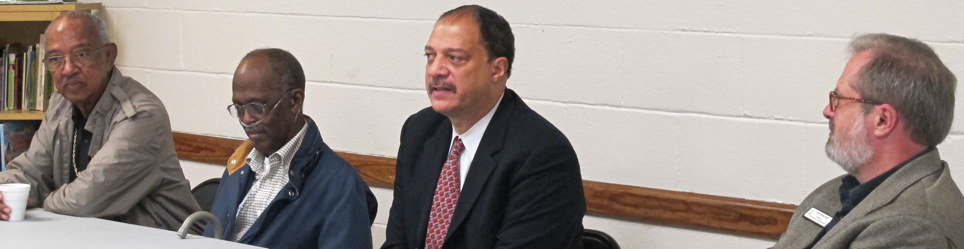
The 2011 links to YouTube videos broke some time ago, so this page will revive material captured at the Forum 15 years ago and link the material back to the Forum’s archive. The 68 minutes of video in 2011 was captured on a small camcorder that was turned off and on to extend its battery life. When the material was prepared for this website, it was left in small pieces to abide by YouTube’s then-current limitation of video to no more than 8 minutes in length. The videos now are housed on this website, without advertising distractions or broken links.
Once again, Brown v Board is top-of-mind, and this background may help young people understand what prompted the litigation and why it headed to the Supreme Court after a famous dissent by federal judge J. Waties Waring that “segregation in education can never produce equality and that it is an evil that must be eradicated.”
– – – – –
1. Joseph A. De Laine Jr. on the background of Briggs and other cases that were combined under the name Brown v. Board (4:55).
2. Joseph A. De Laine Jr. on the lawyers involved in arguing cases before the Supreme Court (1:26).
3. B.B. DeLaine and Joseph A. De Laine Jr. on how the Briggs case moved to the Supreme Court, and the how Judge Waring’s dissent at the District Court level helped shape the Supreme Court’s final decision in Brown (2:45).
4. Joseph A. De Laine Jr. on Harold Boulware’s role as South Carolina attorney for the NAACP as the Briggs v. Elliott lawsuit was filed in 1950 (1:07).
5. Joseph A. De Laine Jr. on Modjeska Monteith Simkins’ role in the Briggs case, with a warning from B.B. De Laine not to believe all the stories surrounding Briggs that involve hearses (5:18).
6. Joseph A. De Laine Jr. on the segregated environment of Clarendon County, S.C. and B.B. De Laine on education and attitudes – and the ability of African-Americans to manipulate the system of segregation in order to survive so that today’s generation of African-Americans could be here today (7:20).
7. B.B. De Laine recounts a conversation with a high school student who asked why desegregation advocates wanted to eat with white people. De Laine says the teen could not imagine a world with no restaurant at every corner. It was not that blacks wanted to eat with whites, it was that they wanted to eat. Adults, De Laine said, had failed to equip teens with an understanding of what their forefathers faced (1:41).
8. Joseph A. De Laine Jr. recounts some of the “quiet support” offered by blacks who appeared to be uninvolved in the Briggs v. Eliott case, on the men who guarded the De Laine house after the family received threats against the Rev. Joseph De Laine (2:47).
9. Joseph A. De Laine Jr. on the false claims made on behalf of Modjeska Monteith Simkins, and on Sara J. Fleming, who was beaten for taking a seat on a segregated bus in South Carolina before Rosa Parks was arrested for the same defiance in Montgomery, Ala. (1:26)
10. B.B. De Laine on how in the ’40s and ’50s, and even today, people need to be mentally prepared before getting involved in civil rights activity. (2:12)
11. Joseph A. De Laine Jr. on how widespread education has altered the challenge of bringing African-Americans together. (1:48)
12. B.B. De Laine on the African-American community made strides when people like his father acted on the notion that he was his brother’s keeper. (2:07)
13. B.B. De Laine on the Charlotte lunch counter sit-ins of 1960, and the parents of student participants who worried over losing their jobs over the children’s participation. (2:10)
14. Joseph A. De Laine Jr. on how children played key roles in two of the component cases of Brown v. Board. (6:19)
15. Joseph A. De Laine Jr. and B.B. De Laine discuss the need for each generation to take responsibility to act against wrongdoing. (3:11)
16. B.B. DeLaine on his father’s ethic of taking personal action and not “waiting on the Lord.” (2:49)
17. Joseph A. De Laine Jr. gives an example of his work to be sure that the media get the details of Briggs v. Elliott correct. (2:38)
18. Joseph A. De Laine Jr. suggests that the unsung heroes deserve more credit than they receive for desegregating public schools. (0:43)
19. Sarah Stevenson talks about adding more names of Charlotte’s desegregation trailblazers to a list at the International Civil Rights Center & Museum in Greensboro. (0:51)
20. B.B. De Laine suggests that Brown v. Board had not been implemented until the Supreme Court’s Swann v. Mecklenburg ruling in 1970. (1:08)
21. B.B. De Laine addresses the fallacy of neighborhood schools, and Joseph A. De Laine Jr. the potential for future actions against minorities like the Tulsa firebombings and the Wilmington NC. attacks. (3:26)
22. Joseph A. DeLaine Jr. on black congregations that allowed their ministers to act improperly. (1:03)
23.Tom Hanchett on the Courage exhibit at the Museum of the New South. (1:50)
24. Joseph A. De Laine Jr. and B.B. De Laine on what people can do today to help.(2:45)
25. Tom Hanchett on how the “Courage” exhibit about Briggs v. Elliott helps create conversations about living together going forward. (2:08)
26. Community Relations head Willie Ratchford on how talking about race is possible only if those in the conversations already know and respect one another. (1:29)