
Dec. 2, 2025
Nothing will end this Dillon’s Rule controversy, but here is some background, from Coates’ Canons NC Local Government Law
“The ‘rule’ refers to a standard for judicial interpretation – a guide for judges suggesting that municipal powers should be narrowly construed. It was developed by John Forest Dillon, a judge and scholar who wrote a famous treatise in 1872 about local government law. The rule says:
“’It is a general and undisputed proposition of law that a municipal corporation possesses and can exercise the following powers, and no others: First, those granted in express words; second, those necessarily or fairly implied in or incident to the powers expressly granted; third, those essential to the accomplishment of the declared objects and purposes of the corporation – not simply convenient, but indispensable.’”
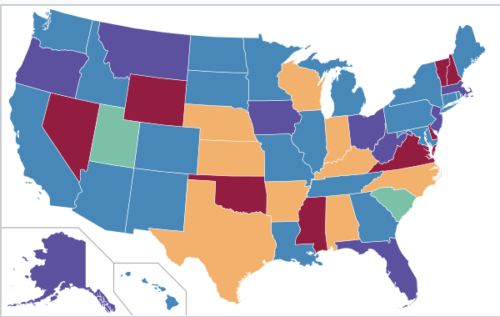
Got that? The folks who have replanted themselves in Charlotte, and particularly those from the states shown in purple, have likely never heard of Dillon’s Rule or seen its effects. They lived in or near cities that control their own destinies. Welcome to North Carolina!
The “decider,” even back in John Forest Dillon’s day, was the state legislature that created the municipal corporation. In fairness, Coates’ Canons note that North Carolina is not a totally Dillon’s Rule state. But as NC legislators have focused more attention on telling big cities what they can and can’t do, Dillon’s Rule is uppermost in city and county leaders’ minds.
Charlotte native Anthony Fox’s summary of Dillon’s rule, in the video above, is informed by decades in private legal practice, acting as legal counsel for municipalities across North Carolina.
– Steve Johnston