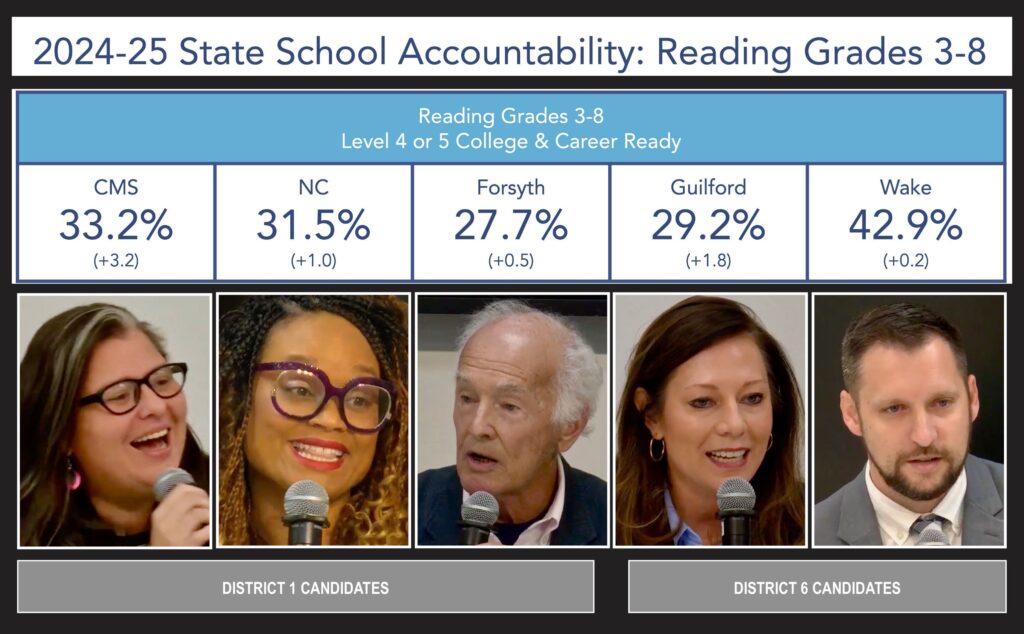
 From left: Melissa Easley, Charlitta Hatch, Bill Fountain, Anna London and Justin Shealy. .
Sept. 16, 2025
The Nov. 4 ballot for nonpartisan elections to the CMS Board of Education will include three candidates for District 1 and three for District 6. District 6 candidate Toni Emehel did not participate this morning.
 By
By CMS board candidates this morning expressed pleasure at last year’s test-score progress. And with the hard work and leadership of Supt. Dr. Crystal Hill.
But the Forum’s back-and-forth between candidates and attendees echoed education policy debates that have dogged the community for decades. And often, when CMS heads off in one direction thinking that community consensus has arrived, a new batch of candidates reopen the discussion.
One takeaway, therefore, appears to be this: The candidates may be superbly reflective of ongoing, unresolved divisions in the community.
Should all students have the support they need? Candidates say yes, but would that ever be possible when neighborhood-based pupil assignment shapes schoolhouses into low-needs and high-needs environments where a child’s luck of the assignment draw can have huge impact on that child’s future.
Does preparation of children for school, and ensuring that children in fact attend class, begin at home? Well, yes. But what is the schools’ role in ensuring that all students have the support they need?
Staff and students must feel safe for school learning to proceed. But in the current national environment, can parents, or CMS staff, be expected to ensure a sense of safety among children who are learning every moment of the day?
Parents’ participation in their child’s schooling is vital, yes, yes. But does that participation always look the same across socioeconomic and other divides?
Attending the Forum were all District 1 candidates – Melissa Easley, Bill Fountain and Charlitta Hatch – and two District 6 candidates – Anna London and Justin Shealy. District 6 candidate Toni Emehel was not present.
Among the matters raised were marketing public schools to incoming residents; ensuring that children see themselves in the adults around them; administrative costs rising while student census is stable or decreasing; closing achievement gaps among student demographics; the need to prepare more students for non-college careers.
